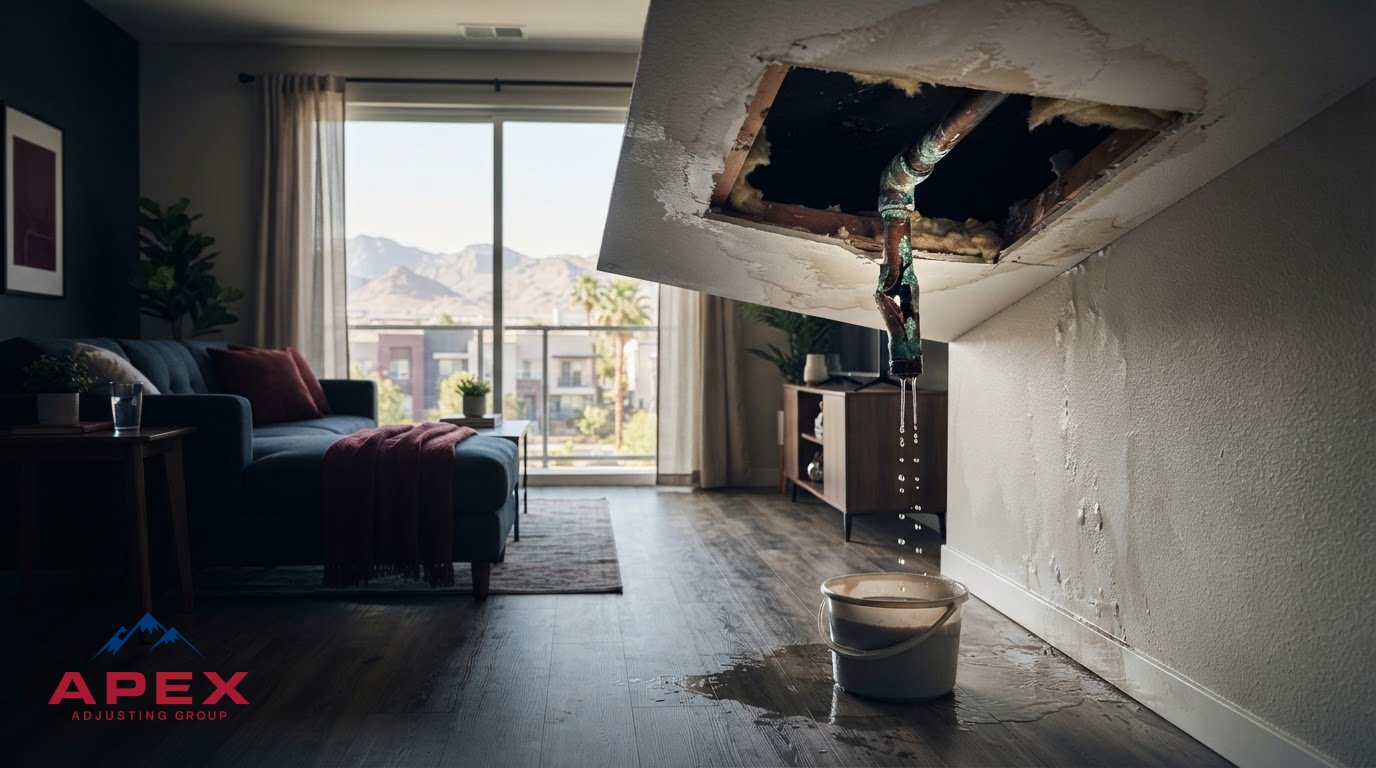
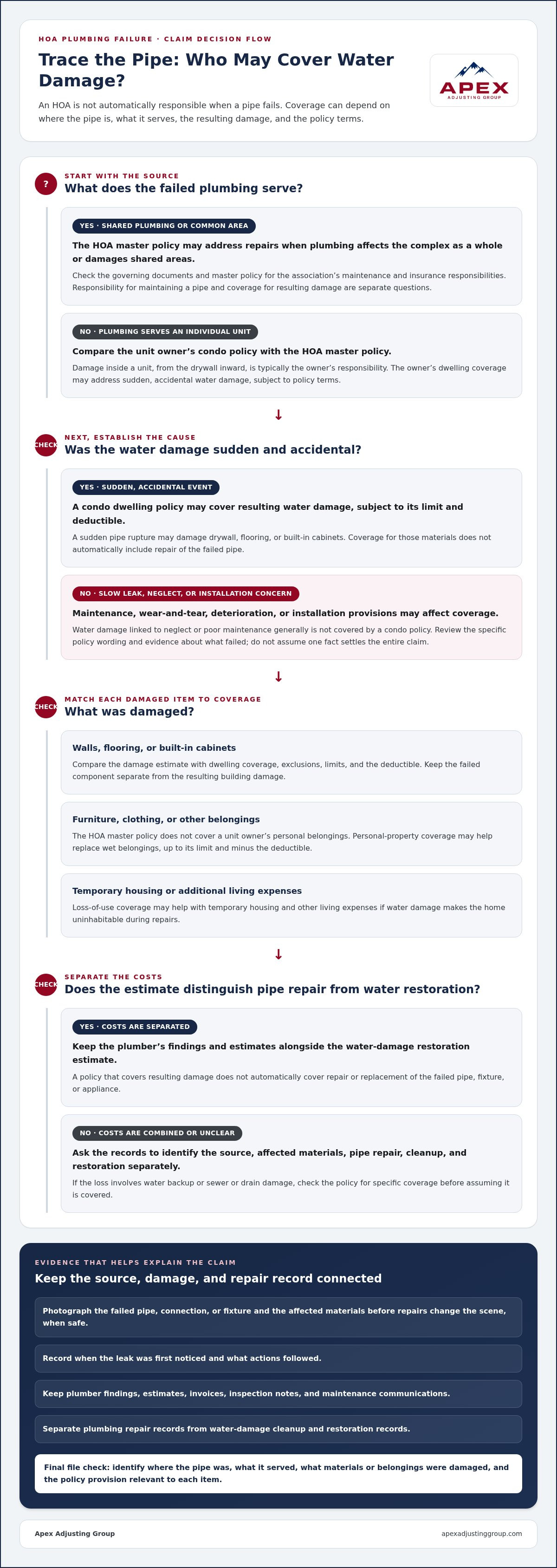
The HOA isn’t automatically responsible when a pipe fails. For a Las Vegas HOA plumbing failure insurance claim, coverage may depend on whether the damaged plumbing serves shared areas or an individual unit, what the HOA’s master policy covers, and what the owner’s condo policy provides. The HOA policy may cover damage to common areas, while the unit owner’s policy may cover sudden and accidental water damage inside the home.
It’s reasonable to expect the party responsible for a pipe to address the damage, but responsibility and insurance coverage don’t always align. The pipe’s location, what it serves, the governing documents, and the policy terms all matter.
This article explains when an HOA may cover plumbing-related damage, how responsibility can differ between shared areas and a condo unit, and what to document for a claim. You’ll learn how to report the loss, preserve evidence, and respond if a claim is delayed, denied, or leaves damage unaddressed.
Key Takeaways
- HOA coverage often turns on whether the failed plumbing serves a shared area or an individual condo unit. Compare the master policy with your own policy before deciding who may handle the damage.
- Dwelling coverage may help pay for sudden, accidental water damage, while personal belongings and temporary living expenses depend on separate policy provisions and limits.
- Neglect, poor maintenance, and the source of the leak can affect coverage. Keep records that show where the water came from and what condition the plumbing was in.
- Water backup and sewer or drain damage may require specific coverage. Review the policy language before assuming the loss is covered.
- For a stronger claim file, photograph the damage and the failed plumbing, keep repair and mitigation records, and report the loss to the appropriate insurer.
Do HOAs cover plumbing?
Sometimes. Coverage depends on the failed pipe’s location, what it serves, the damage, and the policy terms.
Covered Plumbing Perils
A covered plumbing event is a sudden, accidental incident that causes water damage, such as a burst pipe. A condo dwelling policy may cover resulting repairs, subject to its limit and deductible. Coverage for damaged walls or flooring doesn’t automatically include repairing the failed pipe.
Compare the dwelling coverage and exclusions with the damage estimate. A sudden pipe rupture, for example, may damage drywall, flooring, or built-in cabinets. A malfunctioning appliance may cause covered water damage, but condo insurance generally doesn’t pay to repair or replace the appliance itself. Standard condo policies typically exclude flood damage.
Mechanical-breakdown coverage concerns equipment failure, not every loss resulting from a plumbing problem. When documenting the claim, separate the failed component from the resulting water damage. Record the source, affected building materials, and damaged belongings.
HOA Master Policy and Unit Damage
An HOA master policy may cover repairs when plumbing affects the complex as a whole or damages shared areas. It doesn’t cover a unit owner’s personal belongings. This distinction matters when one incident damages both a hallway and a condo interior.
Inside a unit, damage from the drywall inward is typically the owner’s responsibility. The owner’s dwelling coverage may pay for sudden, accidental water damage, while personal-property coverage may help replace wet furniture or clothing, up to its limit and minus the deductible. Loss-of-use coverage may help with temporary housing and other living expenses if water damage makes the home uninhabitable during repairs.
Compare how the master policy treats shared property with the owner’s policy provisions for unit interiors. Review covered property, water-damage language, exclusions, limits, and deductibles. One policy may address common-building repairs, while another applies to interior finishes or belongings.
Shared Plumbing Requirements and Repair Costs
The association’s governing documents and master policy describe its maintenance and insurance responsibilities for shared plumbing. Read them separately: responsibility for maintaining a pipe and coverage for resulting damage are different questions. Identify the pipe’s location and which units or common areas it serves.
There is no single typical cost for Las Vegas plumbing repairs and water restoration. The scope depends on the failed pipe or fixture, how far the water traveled, which materials were affected, and whether drying or reconstruction is needed. A localized leak differs from water affecting several rooms or shared spaces.
Photograph the source and affected materials before repairs change the scene. Keep the plumber’s findings and estimates, separating pipe-repair work from water-damage restoration. These records help explain the failure and resulting damage without assuming one policy covers every cost.
Negligence and improper installation exclusions
Water damage linked to neglect or poor maintenance generally isn’t covered by a condo insurance policy. Improper installation can also complicate a claim because the policy wording and evidence about what failed matter. A denial or reduced payment may depend on whether the damage resulted from a sudden event or a condition that developed over time.
Separate the plumbing failure from the resulting damage. A slow leak beneath a sink, for example, may leave staining, swollen cabinets, and damaged flooring. This can raise questions about when the leak began, whether it was visible, and what maintenance occurred. A sudden pipe break presents different facts, but the policy still determines coverage.
Read wear-and-tear, deterioration, and maintenance provisions in context. Don’t assume the word “wear” settles the entire claim. Identify the affected materials, water source, and specific policy provision cited in any coverage decision. If the response points to poor upkeep, compare that explanation with dated photographs, maintenance records, and inspection observations.
Installation concerns also call for evidence. Preserve invoices, work orders, product information, and communications about prior plumbing work. If a connection separates or a pipe leaks near a recently serviced fixture, document its location and visible condition before cleanup changes the scene. These records help distinguish an installation issue from unrelated damage or a separate plumbing failure.
Las Vegas property owners can reduce failure risks by checking accessible plumbing areas, responding promptly to leaks, and keeping maintenance records. To limit claim disputes, photograph the source and damage, save repair documents, and report the loss accurately without guessing at its cause.
- Photograph the failed pipe, connection, or fixture before removal, when safe.
- Record when the leak was first noticed and what actions followed.
- Keep invoices, inspection notes, and maintenance communications together.
- Separate plumbing repair records from water-damage cleanup and restoration records.
These details can clarify whether the file concerns sudden damage, ongoing leakage, or maintenance. If a water-damage claim appears underpaid or disputed, a review of the claim documentation can help assess the damage record and policy response.
Is an HOA responsible for water damage to your condo?
Responsibility depends on the pipe’s location, what it serves, and the damage involved. In a condo, water damage from the drywall inward is typically the owner’s responsibility. Owners may also be responsible for maintaining and repairing plumbing pipes within their units.
Nevada HOA governing documents explain how the association assigns plumbing-maintenance and property responsibilities. Compare their language with the pipe’s location and the areas it serves. A line inside one unit and a shared line serving common areas raise different claim questions. Keep the relevant document pages with the plumber’s findings and claim records.
An owner shouldn’t assume a repair bill or insurance deductible automatically belongs to them. Ask the HOA for an itemized explanation identifying the work, affected property, and document provision or policy term it relies on. Separate the plumber’s charge for fixing the source from costs for water-damaged finishes or belongings. That breakdown shows which costs are being assigned and why.
Trace the water source before evaluating the loss. A leak from a pipe inside a condo differs from a failure in a shared line. Water damage originating in a unit through the owner’s negligence is generally the owner’s responsibility. Record the source and affected locations rather than relying only on the room where water appeared.
Water backup requires a separate coverage review. Standard condo policies usually exclude sewer or drain backup damage, although optional water-backup coverage may be available for an additional cost. Review the endorsement’s terms, limit, and deductible. Don’t assume a drain overflow is treated like water from a burst supply pipe.
For a backup event, document where the water entered and which drains or fixtures were involved. Preserve the plumber’s findings, cleanup records, and photographs of affected surfaces. If the HOA manages the relevant shared area, notify the association in writing and keep a copy. These records help distinguish the water source from the resulting damage.
Treat repair responsibility, insurance coverage, and any proposed owner charge as separate questions. Compare the association’s written explanation with the unit policy and claim documents. If an invoice combines pipe repairs, cleanup, and interior restoration, request a breakdown so each cost can be assessed against its source and affected property.
The governing documents explain how the association assigns plumbing-maintenance and property responsibilities. Consider their provisions alongside whether the pipe is within a unit or serves shared areas.
HOA responsibility for water damage in shared areas
A leaking pipe can damage a hallway, lobby, stairway, or clubhouse, not just a condo. In a Las Vegas complex, the HOA master policy may cover water damage to shared areas, but responsibility varies by case.
Start with the damaged property and water source. A pipe serving common areas differs from a line inside one unit, helping identify which policy may respond. The HOA master policy may address repairs to common property, while an owner’s condo policy may apply to damage within the unit. Policy language and association documents help clarify the scope of each.
A shared-roof leak can also affect multiple areas. Depending on the policy, the HOA master policy may help cover resulting water-damage repairs. For example, water might stain a common hallway ceiling and seep into a unit’s interior. Record each affected area separately so shared-building and unit damage are both included in the estimate.
Build a clear record of the loss as soon as it’s safe. Photograph the leak source, visible water paths, and each damaged surface. Include common-area features such as lobby ceilings, stairwell walls, hallway flooring, and clubhouse finishes. Note which areas are shared and which are inside a privately owned unit.
- Report the leak and affected shared spaces to the HOA in writing.
- Photograph the source, water marks, damaged materials, and surrounding area.
- Keep copies of the HOA’s incident records and communications about the loss.
- Separate photos and repair documents for common areas from those for unit interiors.
- Record any water movement between a shared space and an individual condo.
Separating the areas helps prevent shared-area repairs from obscuring damage inside a unit. It also gives the association and insurers a clearer record of the loss. If a hallway ceiling and a unit’s flooring are both affected, label the photos by location and connect each item to the observed water path.
Review the HOA master policy’s treatment of shared property, water damage, exclusions, limits, and deductibles. Then compare it with the owner’s condo policy for interior finishes and belongings. A master policy’s involvement doesn’t automatically establish coverage for every item damaged inside a unit.
For a shared-roof leak or common-pipe failure, preserve evidence before cleanup alters the scene. Keep inspection notes, mitigation records, and repair estimates with the photographs. An organized file can show which areas were damaged, how the water traveled, and which repairs address each part of the property.
Steps for filing a plumbing insurance claim
A strong plumbing claim file connects the failure, water path, and each damaged item. Notify the HOA and relevant insurer promptly, then keep copies of every report, photograph, estimate, and written response.
Nevada claim and HOA notice deadlines can depend on the policy, governing documents, and circumstances. Read the notice provisions and report the loss promptly. Don’t rely on an assumed deadline or wait for the full repair estimate before giving notice.
- Limit ongoing damage. Take reasonable steps to protect the property and arrange necessary emergency mitigation. Keep invoices and describe which work stopped further damage versus repaired permanent materials.
- Record the source and damage. Photograph the failed pipe or fixture, nearby surfaces, water marks, and affected contents. Capture wide views and close-ups, and note the room or shared area shown in each image.
- Notify the right parties. Send written notice to the HOA when shared plumbing or common areas may be involved. Report the loss to the applicable property insurer, and save dates, confirmation numbers, and copies of messages.
- Organize supporting documents. Gather the plumber’s findings, mitigation records, repair estimates, maintenance history, and damaged-property inventory. Separate shared-area costs from unit repairs and personal belongings.
- Review the claim response. Compare the insurer’s estimate or decision with the observed damage, submitted records, policy provisions, limits, and deductible. Track items included, omitted, or disputed.
For example, if a shared line leaks into a hallway and a condo, keep hallway photos separate from unit interior photos. Label the plumber’s report with the leak location and match each estimate item to the area it addresses. This makes the scope easier to follow.
If the HOA or insurer denies the claim, request the written explanation and identify the cited policy provision or section of the governing documents. Compare the reason with your evidence, then submit relevant records or a written correction through the applicable claim process. Keep the denial, correspondence, and response together.
Don’t discard damaged materials before documenting them, unless removal is necessary to prevent further harm. When safe, photograph them first, retain samples when practical, and record why removal was needed. A complete file helps clarify what failed, what was damaged, and which costs relate to each part of the loss.
For a review of a plumbing water-damage claim file, request a free claim review.
Applicable deadlines depend on the policy, governing documents, and claim circumstances. Review the notice provisions and promptly notify the HOA and relevant insurer.
Apex Adjusting Group: Fire Damage Claims
Apex Adjusting Group represents property owners with first-party water-damage claims, including plumbing-related losses. If a claim is delayed, denied, or appears to omit damage, a public adjuster can review the policy response, repair estimates, and supporting documentation.
For an HOA plumbing loss, a claim may involve a condo owner’s interior, damaged belongings, or commercial property. Apex Adjusting Group can assess documented water damage and help clarify the claim scope. The firm represents property owners, not insurance companies, in property-damage claims.
Owners with an active or recent water damage claim can request a free claim review or contact Apex Adjusting Group to discuss the file.
Move Your Plumbing Claim Forward
A Las Vegas HOA plumbing failure insurance claim can leave owners balancing association records, policy documents, and repair evidence. Organize the claim file to show what failed, which property was damaged, and which costs remain unresolved. Keep the records together as estimates and claim decisions arrive.
Apex Adjusting Group represents property owners with first-party property-damage claims. Its services include Water Damage Claims, Fire Damage Claims, and Commercial Claims. For a plumbing loss, this support may be relevant when water damage is underpaid, delayed, or denied, or when a commercial property is affected.
Bring the claim correspondence, estimates, photographs, and policy response together for a focused review. Clear documentation gives the loss a stronger foundation for the next discussion.
Move forward with an organized record and a clear view of the damage. You don’t have to sort through a difficult claim file alone.
Frequently Asked Questions
Who is responsible for plumbing failures in Las Vegas HOA communities: the owner or the association?
Responsibility depends on where the failed pipe is, what it serves, and the community’s governing documents. For a Las Vegas HOA plumbing failure insurance claim, determine whether the pipe serves one condo or shared property, then compare that finding with the association’s maintenance provisions. A pipe inside a unit and a common line serving several homes can involve different maintenance responsibilities and insurance policies. Keep the plumber’s findings tied to the pipe’s exact location.
Does homeowners insurance cover plumbing failures, water damage, and resulting repairs in Las Vegas?
A condo owner’s policy may cover sudden, accidental water damage, subject to its terms, limits, and deductible. Coverage for damaged flooring or cabinets doesn’t necessarily pay to repair the failed pipe or appliance. The cause matters too: neglect-related damage is generally excluded, and standard policies usually exclude sewer or drain backup unless optional water-backup coverage applies. Review the coverage decision by damage category rather than treating all plumbing-related costs as one item.
How do owners file an insurance claim after an HOA plumbing failure in Las Vegas?
Notify the HOA and the insurer whose policy may cover the affected property, and keep a copy of each notice. If water affected a shared hallway and a privately owned condo, keep those damage scopes distinct. Submit a clear account of the event, the plumber’s findings on the source, and the affected property areas. Track each claim reference and written response separately so the association’s master-policy file isn’t confused with the owner’s unit-policy claim.
What evidence and documentation should be collected for an HOA plumbing insurance claim?
Collect evidence linking the plumbing source to each damaged area. Keep the plumber’s written findings, photos of the pipe or fixture, and images showing water paths and affected materials. Save mitigation invoices, repair estimates, maintenance records, and HOA communications. For damaged belongings, record each item’s description and condition, and keep available purchase or ownership records. Label files by room or shared area so reviewers can match documents to the claimed damage.
What do Nevada HOA governing documents say about plumbing maintenance and damage responsibility?
The governing documents describe the association’s maintenance and insurance responsibilities for shared plumbing. Compare their provisions with the pipe’s location and the areas it serves: responsibility for maintenance and coverage for resulting damage are separate questions.
Need Help with Your Insurance Claim?
Our licensed public adjusters can help you get the maximum settlement you deserve. Contact us today for a free claim evaluation.
Related Articles