A San Francisco property owner facing a Victorian soft-story earthquake damage claim needs to understand the physical damage, the policy’s earthquake coverage, and the records connecting the loss to the quake. Large ground-floor openings can leave a building with fewer walls to resist side-to-side shaking, increasing the risk of structural damage and displacement. Wood framing alone doesn’t remove that vulnerability.
Owners and residents need to know whether the building is safe to occupy and how repairs, loss of use, and damaged property may be addressed. Coverage depends on the policy in force and the damage documented, so a structural problem does not automatically mean every related expense is covered.
This article explains how soft-story design and shear forces affect San Francisco Victorians, why earthquake damage can disrupt homes and businesses, and what to review in the policy and claim file. It also covers the photos, repair assessments, and records that can document the damage and support a clearer claim review.
Key Takeaways
- Identify ground-floor openings and other soft-story features that may leave a Victorian more vulnerable to earthquake movement.
- Separate structural damage, damaged contents, and loss of use when reviewing what an earthquake policy may cover.
- Document visible damage and keep repair assessments and claim correspondence together to support a clear record of the loss.
- San Francisco’s soft-story requirements apply to certain buildings, so understand how retrofit status relates to the property’s condition and claim file.
- When a claim is delayed, denied, or appears underpaid, a property owner can seek a professional review of the damage documentation and insurance adjustment.
Soft-story building damage and displacement
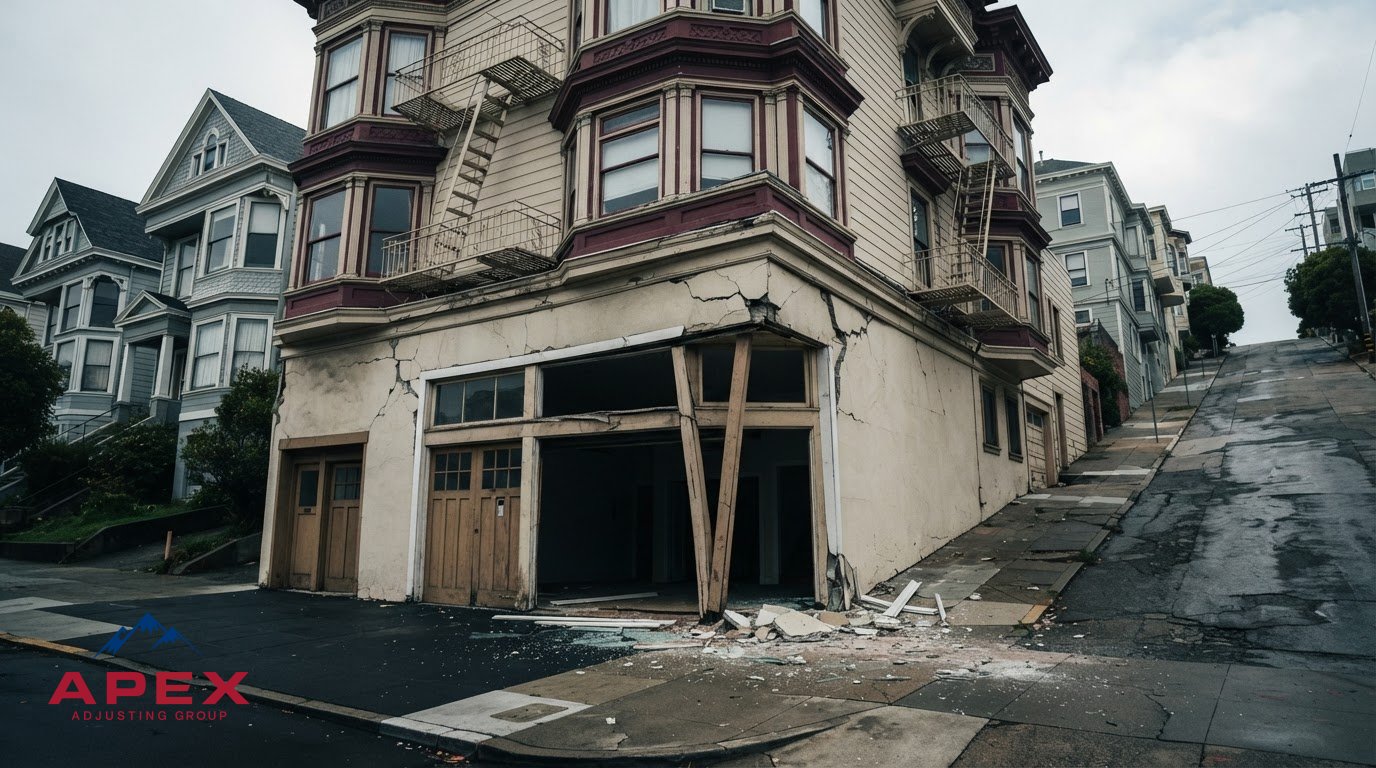
In San Francisco, an open ground floor can leave a Victorian with fewer walls to resist earthquake forces. Damage may affect structural stability, occupancy, and the evidence needed to document an insurance claim.
Soft-Story Building Characteristics
A soft-story building has a ground floor that is less able to resist side-to-side movement than the floors above. A common example is a parking garage or retail space beneath two or more residential floors. San Francisco buildings may have large first-story openings for these uses. Homes with stand-up-height crawl spaces at ground level can also fit this description.
Look beyond the exterior style. Wood construction does not necessarily prevent earthquake damage if the lower level can move laterally. For a Victorian, note open garage bays, storefront openings, and how much solid wall remains on the ground floor. These features help explain why the building’s layout matters alongside its age and materials.
Seismic Vulnerability in High-Risk Zones
In a high-seismic zone, strong shaking can push a building from side to side. Large ground-floor openings leave fewer walls to resist shear, concentrating movement and damage at the weaker level. The upper floors may remain standing even as the first story suffers severe damage, making rooms unsafe to occupy.
San Francisco’s Marina District is also prone to soil liquefaction, which can affect how the ground supports buildings during shaking. The neighborhood’s soil conditions and a building’s ground-floor layout are separate factors, but both matter when assessing earthquake damage. An estimated 43% to 85% of soft-story buildings may be uninhabitable following a major earthquake.
A major earthquake could potentially displace 58,000 residents, 2,000 businesses, and 7,000 employees from soft-story buildings. These estimates show how damage to a single building type can disrupt housing and commercial activity across San Francisco.
Claim Evidence and Inspections
Useful claim evidence documents the damage, affected areas, and building condition after the earthquake. Photograph each elevation, ground-floor opening, visible crack, shifted wall, and damaged interior area. Keep the images in their original form, and note where and when each was taken.
For an earthquake damage claim, preserve inspection reports, repair assessments, and records showing whether rooms or business areas can be used. A qualified structural professional can assess visible movement and structural concerns. Written findings can help distinguish cosmetic damage from damage affecting stability. Keep these findings with dated photographs and claim correspondence.
San Francisco’s building codes require seismic or soft-story retrofits for certain types of buildings. Some buildings had a soft-story retrofit requirement by 2017, but that does not mean every Victorian has the same requirement. To understand how retrofit rules apply, identify the building’s features and applicable records rather than assuming age or Victorian design alone decides the issue.
Earthquake insurance
The policy and endorsements in force for the San Francisco property determine how earthquake damage is addressed. Review the coverage terms, deductible, and claim correspondence together before assessing what the insurer has included.
Claim Filing Steps
Start by promptly notifying the insurer and clearly describing the earthquake damage. Provide the property location, date of loss, affected areas, and any immediate safety concerns. Ask for the claim number, and keep a record of each submission, conversation, and inspection appointment.
Then review the declarations page and earthquake endorsement. Confirm which property and coverage categories are included, such as the dwelling, personal property, and additional living expenses, if listed. A separate earthquake deductible may apply. Read its terms and calculation in the policy rather than assuming they match another type of claim.
- Save the policy, declarations, endorsements, and claim forms together.
- Record damaged building components, contents, and areas that cannot be used.
- Keep receipts and written communications related to the loss.
These records connect the reported loss with the coverage being requested. For a Victorian with structural damage and displaced occupants, keep building repairs and temporary living expenses clearly separated in the claim materials.
Claim Deadlines and Appeals
California earthquake claim deadlines depend on the policy language and dates stated in claim correspondence. Review the policy’s notice and proof requirements, then note every date in letters or claim forms. Contact the insurer promptly if a deadline or requested document is unclear.
There is no single deadline for every California earthquake claim or appeal. Follow the insurer’s written instructions and applicable policy terms for an appeal or reconsideration request. Keep copies of the decision, its explanation, and any documents submitted in response. A timely written record shows what was disputed and when.
Denied or Underpaid Claims
If the insurer denies the claim or the estimate appears incomplete, begin with the written decision and itemized estimate. Identify the specific damage or cost omitted, such as a visibly cracked wall or a repair item missing from the estimate. Compare each item with the policy language and records already submitted.
Send a focused written response identifying the disputed items and attaching relevant documentation. Request clarification if the explanation does not address a damage category or policy provision. Keep the response, attachments, and delivery record with the claim file. Do not treat a partial payment as a complete accounting without reviewing its scope.
Owners who need an independent review of an active or recent earthquake claim can request a free claim review. A careful comparison of the policy, estimate, and documented damage can clarify which issues need attention.
Earthquake vulnerability and shear forces
Earthquake shaking pushes a building horizontally, not only downward. Shear is the force acting across walls, floors, and connections as the structure moves. In a San Francisco Victorian, the load path matters: upper floors transfer movement toward the foundation through connected framing. A weak link can concentrate movement and damage instead of distributing it through the building.
Consider a ground floor opened for parking or retail beneath residential rooms. Fewer solid wall sections resist sideways force while the floors above continue moving. That mismatch can place greater demand on the remaining walls, posts, and connections. Damage may include cracked finishes, shifted framing, or visible separation at joints, but a surface crack alone does not establish the full structural condition.
Shear resistance depends on how connected components work together. Wall framing must transfer forces through floors and into the foundation; gaps or weak connections can interrupt that path. A structural inspection can examine the framing, wall layout, and connection points. For the claim record, photograph the same wall or joint close up and from across the room, showing its location and surrounding structure.
San Francisco Victorians can differ substantially despite similar exterior styles. One building may have a largely open storefront level, while another retains more continuous wall sections. A stand-up-height crawl space can also create a soft-story condition. The practical question is not simply whether the building is wood-framed, but how its lower-level walls and connections resist lateral movement.
Retrofit measures address structural weaknesses by strengthening the building’s load path. Soft-story walls can be reinforced with sandwich plates, bolts, and posts connecting the structure from side to side. Seismic retrofits can also reinforce wall and roof connections, strengthen foundations, or install seismic dampers. Because these measures address different parts of a structure, a retrofit description should identify the components actually changed.
For some soft-story homes, plywood nailed to wall studs can add wall strength and improve earthquake protection. This differs from simply covering a damaged surface: the plywood must function as structural reinforcement within the wall assembly. Keep retrofit plans, completion records, and inspection findings with post-earthquake photographs. These documents can help distinguish prior improvements from new movement or damage.
When documenting a San Francisco Victorian after shaking, connect each visible condition to a specific location. Record the floor, room, wall, opening, or connection shown, and include wider views for context. Compare the same areas across inspection notes and repair assessments. This gives a clearer picture of how the building responded, where damage is concentrated, and which structural components need further evaluation.
San Francisco soft-story damage
Earthquake damage in San Francisco depends on the building’s condition, construction, and ground-floor layout. Retrofit obligations and project scope also affect what owners need to document and budget.
Soft-Story Earthquake Damage
Soft-story earthquake damage is concentrated around a building’s weaker ground level and its connections to upper floors. In a Victorian with a garage or storefront opening, inspect posts, wall edges, and floor connections for visible displacement or separation. These areas help show how shaking affected the structure, not just its finishes.
San Francisco building codes require seismic or soft-story retrofits for certain building types. Four California cities named as adopting soft-story retrofit ordinances are San Francisco, Berkeley, Oakland, and Los Angeles. A city ordinance and a specific property’s retrofit status are separate questions, so keep building records tied to the address and work performed.
Distinguish new earthquake effects from pre-existing conditions in damage records. Photograph a cracked wall beside its doorway, then take a wider view showing the room and floor. Note whether doors bind, floors appear uneven, or framing has shifted. Include dates and locations, and preserve inspection findings explaining which conditions affect structural stability.
Retrofit Cost Considerations
The cost of a soft-story retrofit depends on the work required for the individual building. The scope can vary with the ground-floor opening, existing framing, foundation conditions, access, and reinforcement design. A parking level with extensive openings may need different work from a home with a limited crawl-space condition.
There is no single cost that applies to every San Francisco Victorian. Compare project estimates by their stated scope, such as wall reinforcement, connection work, foundation strengthening, or seismic dampers. The listed work, materials, access needs, and building conditions explain differences between proposals. Keep plans, inspection records, and invoices with the property documents.
California’s 2019 law requires all soft-story buildings to be retrofitted by 2030. That statewide requirement does not replace San Francisco’s building-code requirements for certain building types. Owners should distinguish a retrofit project’s compliance scope from repairs caused by earthquake damage, because the two can involve different work and documentation.
A retrofit may strengthen a building, but it does not by itself establish the extent or cause of later earthquake damage. For an insurance file, preserve pre-retrofit records alongside post-event inspection findings and photographs. This lets reviewers compare the documented condition before and after shaking, including newly affected walls, connections, or foundation areas.
Filing an Earthquake Insurance Claim in San Francisco
A San Francisco earthquake claim needs a clear account of the loss, policy coverage, and supporting records. For a San Francisco Victorian soft-story earthquake damage claim, organize the file by damage type and property area so the insurer can assess each part.
Report the Loss and Organize the File
Start by notifying the insurer using the method described in the policy. Record the claim number, date reported, and name or department receiving the notice. Describe the earthquake and affected areas plainly, such as a shifted ground-floor post, cracked interior wall, or damaged contents.
Keep the policy, declarations, earthquake endorsements, photographs, inspection notes, estimates, and insurer correspondence together in one claim folder. Separate structural damage from personal property and additional living expenses. This organization makes it easier to see which parts of the loss are documented and which still need attention.
- Photograph each affected room, exterior elevation, and visible structural condition.
- Label images with the date, location, and building area shown.
- Save receipts and records for temporary housing, protective measures, or damaged contents.
- Keep a dated log of inspections, calls, emails, and documents sent.
Match the Damage to the Policy
Review the declarations and earthquake endorsement to identify the insured property, coverage categories, deductible, and claim requirements. Because the deductible affects how the covered loss is calculated, use the policy’s wording rather than assuming it matches another coverage section. Note any terms the insurer cites in its estimate or claim decision.
For example, an estimate may include visible wall repairs without explaining whether anyone evaluated the ground-floor framing or a displaced post. Compare the estimate line by line with photographs and inspection findings. Mark each difference and gather supporting documentation, such as a structural assessment or repair scope.
Track Inspections and Claim Decisions
During an inspection, identify areas that changed after the earthquake and point out specific locations. A dated photo of a crack should include a close view and a wider image showing its room or wall. Keep the inspector’s notes and follow-up requests with the same location-based records.
When a decision or payment arrives, compare its scope with the reported damage and policy terms. For a San Francisco Victorian soft-story earthquake damage claim, identify any missing building component, contents category, or temporary living expense, then support it with the relevant record. Retain every submission and note response dates so the file shows what was reviewed and disputed.
If questions remain about the claim file, owners can request a free earthquake claim review.
Apex Adjusting Group: Fire Damage Claims
Apex Adjusting Group helps property owners assess active or recent claims when damage appears underpaid, delayed, or denied. For a residential or commercial property claim, its review can examine the policy, damage documentation, estimates, and claim correspondence to identify gaps in the recorded scope.
Clear records matter in a complex loss. Organized photographs, inspection findings, and repair estimates help show what was damaged and what the claim evaluation addressed. Apex represents property owners in first-party property damage claims, not insurance companies.
For a no-pressure next step, request a free claim review.
Put the Claim File on a Clear Path
The next step is to make sure the claim record reflects the full loss, not just the most visible damage. A well-documented San Francisco Victorian soft-story earthquake damage claim gives the review a clear basis: the policy, inspection findings, estimates, and records of affected areas should tell a consistent story. If the insurer’s evaluation omits documented damage or a relevant cost, identify the specific gap and supporting evidence.
Apex Adjusting Group represents property owners in property damage claims, including fire damage, water damage, and commercial property claims. A claim review can help clarify the file and identify issues that may need further attention.
Owners can request a free claim review to discuss an active or recent claim.
Take the next step with an organized claim record and a clearer understanding of the issues.
Frequently Asked Questions
What qualifies as a soft-story Victorian building in San Francisco?
A Victorian may be considered soft-story when its ground floor is less able to resist side-to-side movement than the floors above. Examples include a home with a stand-up-height crawl space or an apartment building with parking or retail beneath two or more residential floors. The architectural label alone does not determine this. The building’s ground-floor layout and structural characteristics matter when assessing its vulnerability.
What earthquake damage risks are common in San Francisco Victorian soft-story homes?
Damage can include movement or failure around ground-floor walls, posts, and connections, along with shifted framing or interior cracking. For example, a garage opening may leave fewer wall sections to resist sideways movement, increasing stress on the remaining supports. In San Francisco’s Marina District, soil liquefaction adds a ground-condition concern. A structural assessment helps distinguish finish damage from conditions affecting building stability.
Does California homeowners insurance cover earthquake damage to a Victorian soft-story building?
Coverage depends on the policy and any earthquake endorsement, so do not assume a homeowners policy automatically covers earthquake losses. Review the declarations, endorsements, deductible, covered property, and claim requirements. Confirm whether the policy addresses the building itself, personal property, and additional living expenses. Compare the insurer’s estimate with the policy terms and documented damage, category by category.
Can earthquake insurance cover retrofit costs or only earthquake damage?
Whether a policy covers retrofit work depends on its wording and the reason for the work. A retrofit planned to strengthen a building before an earthquake differs from repairs to components damaged by shaking. Review the policy provisions and separate retrofit plans from post-event repair estimates. For example, keep an engineer’s reinforcement scope distinct from an assessment identifying earthquake-related structural damage.
Need Help with Your Insurance Claim?
Our licensed public adjusters can help you get the maximum settlement you deserve. Contact us today for a free claim evaluation.
Related Articles