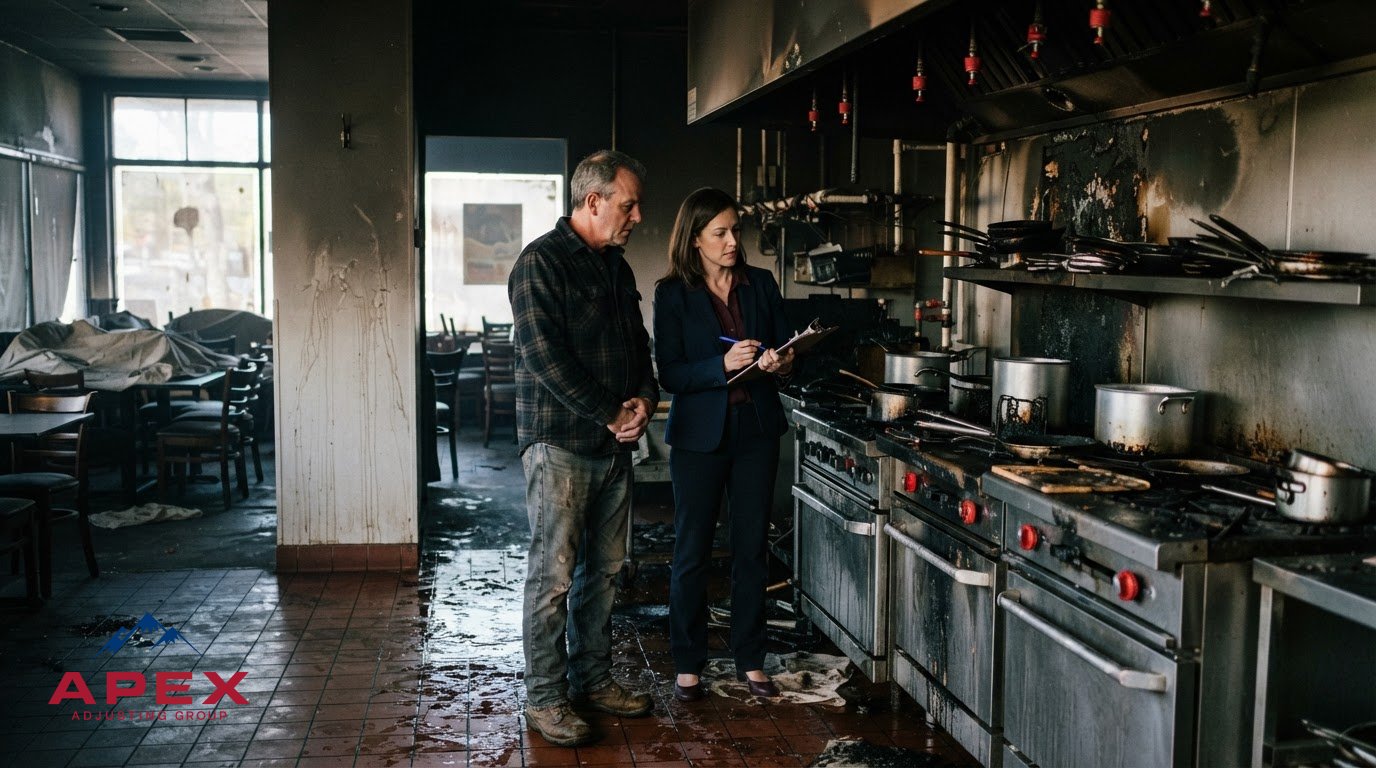
A lump-sum contents estimate leaves too much unanswered. The practical answer to how to document contents loss for a fire claim in Phoenix is to prepare a room-by-room inventory with clear descriptions and estimated values. Similar belongings can be grouped for clarity, but each entry should still identify the item type and quantity rather than rely on one broad total.
A detailed inventory does not require a receipt for every possession. When receipts are missing, purchase dates, approximate values, photos, videos, and financial records can help support your list. For Phoenix property claim support, keep these records organized alongside your inventory.
This guide explains how to record damaged belongings, reconstruct values, and organize evidence for the insurance adjuster. It also covers policy details that may affect how contents are valued, helping you present a clearer, better-supported claim.
Key Takeaways
- Record each damaged belonging with its description, approximate value, and purchase date when possible; note its brand, age, and condition to make the entry more useful.
- Use bank or credit card statements and other available records to help support estimated values when receipts are missing.
- Review whether the policy values contents at actual cash value or replacement cost, since that affects how item values are assessed.
- Keep the policy, fire department report or incident number, proof of ownership, photos, and claim correspondence organized in one file.
- Give the assigned adjuster a complete inventory and supporting documents, and keep copies of everything submitted.
Preparing a room-by-room fire loss inventory
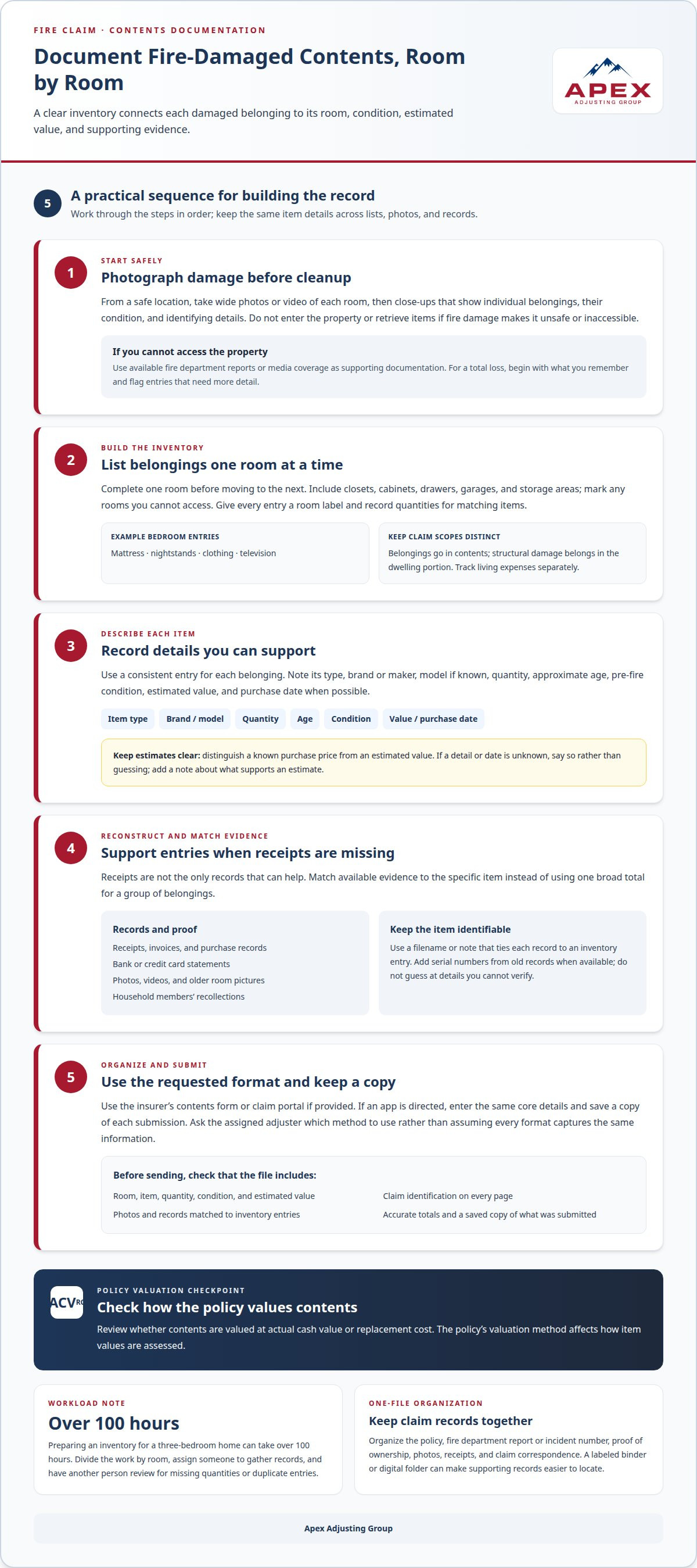
Before cleanup, document damaged personal property from a safe location and create a separate inventory for each room. A personal property inventory records belongings destroyed or damaged, helping distinguish contents from the home’s rebuild scope. For Phoenix homeowners learning how to document contents loss for a fire claim in Phoenix, a clear room-by-room record is the starting point.
-
List belongings room by room
Start with one room and list each damaged or destroyed item before moving on. Include closets, cabinets, drawers, garages, and storage areas, and mark any rooms you cannot access. In a bedroom, for example, list the mattress, nightstands, clothing, and television separately. Note quantities for matching items and keep the room label with every entry.
Separate personal property from building materials and fixtures. A damaged sofa belongs in the contents inventory; structural damage belongs in the dwelling portion of the claim. Track living expenses, such as temporary housing, separately. This helps the adjuster review the contents claim without mixing it with rebuilding costs.
-
Document destroyed or unsafe belongings
Photograph or video damaged belongings before cleanup, but only if it is safe to visit the site. Take wide shots of each room, then close-ups of individual items showing their condition and identifying details. If fire damage makes the property inaccessible, do not enter to retrieve belongings or take closer photos. Use available fire department reports or media coverage to help document the loss.
For a total loss, list items from memory and flag entries that need more detail. Use older room photos, household videos, and family members’ recollections to rebuild the inventory. Do not include items no one owned or list the same item twice. Record what you know, then add supporting evidence as it becomes available.
-
Choose accepted inventory forms or apps
Use the insurer’s contents inventory form or claim portal if one is provided. If the insurer directs you to an app, enter the same core details and save a copy of each submission. Ask the assigned adjuster which submission method to use, and follow those instructions rather than assuming every format captures the same information.
If you begin with a spreadsheet or written list, use consistent columns for room, item, quantity, condition, and estimated value. Name photos and receipts to match inventory entries. Before sending the file, check that every page identifies the claim and that the totals are accurate. Keep a copy of the version you submit.
-
Get help preparing the inventory
Ask a household member to help recall belongings and check rooms against photographs taken before the fire. Preparing an inventory for a three-bedroom home can take over 100 hours. Divide the work by room, assign one person to gather records, and have another review entries for missing quantities or duplicate items.
Professional help can make it easier to organize item descriptions and supporting documents when the inventory feels unmanageable or the claim scope is disputed. Keep control of the facts by reviewing every entry for accuracy before submission. A careful inventory gives the adjuster a clearer record of personal property and keeps contents documentation separate from repair estimates. This room-by-room approach helps Phoenix homeowners document a fire claim consistently.
Recording item descriptions, brands, age, cost, and condition
Precise entries make each claimed item easier to identify and evaluate. Record the facts you can support, then keep the evidence organized with the insurance claim.
-
Record item details and condition
Describe each belonging by item type, brand, model, approximate age, and pre-fire condition. For example, identify a “leather sofa” by maker and model if known, rather than writing only “furniture.” Note whether it was new, regularly used, worn, or already damaged. Add serial numbers from old product records when available, but do not guess at details you cannot verify.
Use consistent descriptions across the inventory, photos, and receipts. For a matching set of dining chairs, record the quantity and any differences in condition. If an item has no label or model number, say so and include other identifying details, such as its color, size, or distinctive features.
-
Estimate values and purchase dates
List each item’s approximate value and purchase date when possible. Use a month, year, or broader estimate if you cannot recall the exact day, and distinguish a known purchase price from an estimated value. Do not present a guess as a figure supported by a receipt. Add a brief note explaining the basis, such as a credit card record, old photo, or household recollection.
Tie each record to the specific item. A purchase record for a laptop, for example, should identify the laptop rather than support a broad electronics total. If the purchase date is unknown, mark it as unknown and keep gathering evidence instead of assigning an unsupported date.
-
Keep receipts and financial records
Gather receipts, invoices, bank statements, and credit card statements that may verify purchases or values. Match each record to an inventory entry with a filename or note, such as “living room television purchase.” Store digital copies with the original records, and keep claim correspondence and receipts together in a dedicated file.
A three-ring binder can hold printed claim documents, receipts, and notes in labeled sections. Add a simple index to locate the policy, fire department report, or purchase evidence without sorting through every page. For an item without a receipt, keep other records that may help establish ownership and value.
-
Document smoke and soot damage
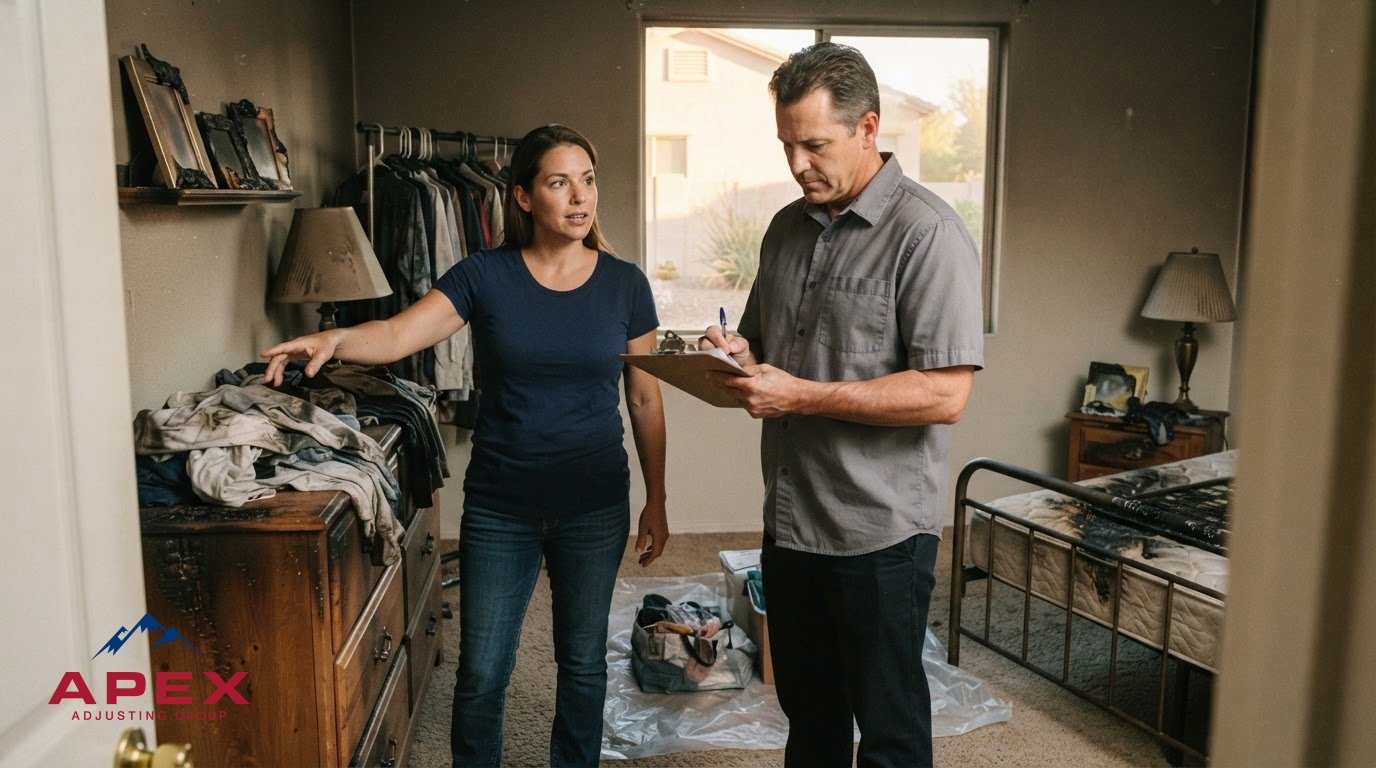
Photograph smoke or soot on each affected belonging before cleaning or moving it. Take a clear overall image, then close-ups showing residue on surfaces, fabric, or electronics. Include visible identifying details, and record the room and condition in the corresponding inventory entry.
Describe impacts accurately, including visible staining, discoloration, or residue, and note odors separately in writing. Do not call an item destroyed if it is still present; describe what you can observe. If soot affects several belongings, document each item or clearly identified group so the adjuster can connect the evidence to the claim.
If purchase records are difficult to reconcile with the inventory, a free claim review can help assess the file.
Coordinating documentation with the insurance adjuster
Keep the contents inventory, policy language, and adjuster’s decisions together in one claim file. A written record makes questions about valuation, missing items, or a low settlement easier to address.
-
Communicate and work with the adjuster
Send the insurance adjuster a complete inventory with supporting records, and keep a copy of every submission. Ask for written clarification if an item is omitted, its condition is disputed, or its valuation differs from your documentation. Identify the specific entry and provide its photo, purchase record, or description instead of disputing the total without details.
After each call, record the date, the adjuster’s name, the topic, and any requested follow-up. If the insurer’s settlement offer does not account for listed contents, compare its itemization with yours and respond with the specific differences. A public adjuster can help property owners assess and manage a disputed property claim.
-
Read the insurance policy
Find the personal property coverage, valuation terms, limits, exclusions, and claim-document instructions in your policy. Actual cash value reflects an item’s pre-loss value, while replacement-cost personal property coverage pays the full replacement cost of belongings. Check which valuation method applies to contents and whether the policy sets out separate steps for replacement-cost benefits.
Compare the policy wording with the adjuster’s estimate, item by item. If a damaged television is valued at actual cash value, ask how its age and pre-fire condition affected the calculation. Keep the relevant policy pages with your inventory so each question points to a specific term or entry.
-
Track claim deadlines and documentation
Review the policy’s proof-of-loss instructions and record each deadline in your claim file. For Phoenix fire claims, proof of loss is due within 60 days under policy terms. This is a policy deadline, not a blanket statement about every Arizona claim requirement; use the deadline and submission instructions in your own policy.
Keep the insurer’s requests, submitted inventory, photos, receipts, and written responses together. If you dispute a low personal property settlement or denial, identify each missing or undervalued item and attach evidence supporting your position. Ask the insurance company to explain its decision in writing, then respond with a clear item-by-item comparison. A free claim review can help assess documentation when a contents decision remains disputed.
Reconstructing values when receipts are unavailable
A missing receipt does not prevent a homeowner from building an evidence-based estimate. Reconstruct the item’s pre-fire value using records, photographs, and condition details, then clearly label any estimates.
- Start with the policy’s valuation method and identify whether the estimate concerns actual cash value or replacement cost. Actual cash value is the item’s pre-loss value, sometimes described as what a willing buyer would have paid immediately before the loss. For a damaged dining table, record its age, material, condition, and comparable purchase information before estimating.
- Search records that connect a specific item to its purchase or ownership. Check email confirmations, online account histories, bank and credit card statements, warranty registrations, and saved product records. A statement may show a store purchase without identifying the item, so pair it with an order email or household photograph when possible.
- Use photos and videos to identify belongings and their condition before the fire. A holiday photo may show a particular television, rug, or appliance in the home. Compare the visible features with saved product information, and note the model or description only when the evidence supports it. Do not use a current listing alone as proof of the item’s former condition.
- Estimate values consistently, distinguishing documented prices from estimates. Record the source beside each figure, such as a purchase email, statement, product record, or image. If you cannot identify the exact model, describe the item’s material, size, approximate age, and pre-loss condition. Avoid assigning a precise purchase date or condition without supporting evidence.
- Tie each reconstructed value to its inventory entry and claim records. For example, include the room and item in every related note or file. Keep contents estimates separate from housing receipts and additional living expenses, which document displacement costs rather than belongings. A fire department report may help establish the incident, but it does not replace evidence for specific items.
- Prepare a short explanation for entries with limited documentation. State what evidence exists, what remains an estimate, and how you arrived at the figure. If the insurance adjuster questions an item’s value, consult the policy’s valuation language and provide the supporting records together. This gives homeowners a clear basis for discussing disputed values without overstating what the file proves.
Supporting a contents claim with documentation
Build an evidence file that connects each claimed belonging to the fire, its condition, and the policy. Keep contents evidence separate from building damage and living expenses.
- Gather the insurance policy, fire department report or incident number, and records identifying the policyholder and property. Keep these documents together as the claim’s reference file. The policy identifies coverage terms, while the incident record helps connect the reported fire to the loss.
Use the same claim identifier on your inventory, photographs, and correspondence. If a document covers multiple subjects, note the relevant page or detail. This makes it easier to show how a specific record supports a contents entry.
- Photograph or video the site if it is safe to visit. Capture room-level views and close-ups of damaged belongings, including visible smoke or soot. Keep the original files and organize copies by room or inventory entry so each image can be matched to the item it shows.
For example, a wide image can show a damaged bedroom, while a close-up documents a dresser’s condition. Record the room and item in the filename or a separate index. Do not enter an unsafe area to gather evidence.
- If you cannot access the property, preserve other available evidence instead of attempting to enter. Drone footage, fire department reports, or media coverage may help document the site. Save the source and date with each file, then identify which rooms or belongings the material can reasonably support.
These records may show the fire’s impact on the property, but they may not identify every personal belonging. Pair them with household photos, videos, or other ownership records when available. Label what each piece of evidence establishes, and do not treat a general image as proof of an unseen item.
- Attach receipts and purchase records to the corresponding inventory entries when available. A receipt for an appliance can support its purchase, while an image may show that it was in the home. Track which evidence supports ownership, description, condition, or value rather than treating every document as proof of every detail.
For items without receipts, keep available photos, statements, or other relevant records. Clearly mark estimated details. A consistent evidence trail helps the adjuster review an item without confusing missing purchase documentation with missing proof of ownership.
- Submit the inventory and supporting documents through the insurer’s stated claim process. Keep the exact version sent, the submission date, and any confirmation or response in your file. If you add evidence later, identify the new material and the inventory entries it supports.
Before sending, compare item names and room labels across the inventory, photos, and receipts. Correct mismatches, such as a photograph labeled “den” when the inventory places the item in a bedroom. Keep copies of every communication and document exchanged during the contents review.
- Keep contents evidence separate from documents for other parts of the fire claim. Receipts for temporary housing or other living expenses belong in a separate record, not among personal belongings. Keep building damage materials separate too, so the contents file stays focused on items such as furniture, clothing, and appliances.
Review the file for missing attachments and unclear descriptions before submitting it. A clear index can connect each inventory line to its evidence. If the contents decision remains disputed, an organized file helps identify which items need more documentation or explanation.
Apex Adjusting Group: Fire Damage Claims
Apex Adjusting Group represents property owners in first-party claims, not insurance companies. Its Fire Damage Claims service can help assess how contents documentation, policy terms, and the insurer’s estimate fit together.
Consider professional claim support when belongings are missing from the estimate, values are disputed, or the claim is delayed or denied. A public adjuster can review the property loss and help manage claim documentation. This is claim representation, not legal advice or repair work.
Apex Adjusting Group works on a contingency fee, with a fee only when a settlement is obtained. Phoenix property owners can request a free claim review to discuss their fire claim, without pressure.
Keep Your Claim Moving Forward
Once you submit your contents file, treat the claim as an active record rather than a finished task. Track new correspondence and decisions alongside the version of your inventory already provided. If a response raises questions, note the specific item or valuation and keep the discussion tied to supporting information.
Knowing how to document contents loss for a fire claim in Phoenix can help you stay organized as the claim progresses. Follow each open issue through to a clear response so a missing item or unresolved question does not disappear in the paperwork. Keep your records accessible and update them when relevant information changes.
If the claim is difficult to manage or a contents decision remains disputed, professional review can help clarify the file and the next practical step. Address one issue at a time. A clear record gives you a stronger footing as you work toward resolution.
A steady, organized approach can help you move the recovery process forward.
Frequently Asked Questions
Can I list similar items in bulk instead of individually?
Yes, group genuinely similar items when each entry shows what the group contains and how many were lost. For example, list matching bath towels together by type and quantity, but enter a designer coat or specialized appliance separately. Follow any grouping instructions in the insurer’s inventory format. If an entry combines different brands, models, or conditions, split it so the adjuster can understand what the total represents.
How do I estimate replacement costs without original receipts?
Use available product details to identify a reasonable current equivalent, then document how you chose it. A saved product page, model number, household photo, or warranty record may help distinguish a comparable replacement from a different item. Note whether your estimate reflects replacement cost or actual cash value under the policy. Keep the evidence with the estimate, and do not treat a newer or upgraded model as an exact match.
When should I hire a professional for inventory help?
Consider professional inventory support if the loss involves numerous rooms, extensive smoke damage, inaccessible areas, or disagreements about missing belongings. It may also help when the insurer’s item list differs substantially from household records. Before sharing documents, organize the current inventory and note unresolved entries. A clear starting file helps focus the review on gaps, valuation questions, and specific claim issues.
How do I create a room-by-room inventory of belongings lost in a house fire?
Start with a floor plan or room list, then work through each space in a consistent direction. Include less visible storage areas, such as closets, cupboards, and garage shelves. In a kitchen, separate small appliances, cookware, dishes, and pantry contents instead of writing “kitchen items.” Mark inaccessible rooms and return only when it is safe. A household member may help identify items that are not apparent in photographs.
What evidence can document personal property loss for a fire insurance claim?
Useful evidence may include dated household photos, videos, purchase confirmations, warranty records, bank statements, and credit card statements. A fire department report or incident number can help connect the loss to the event. Match each record to the item or category it supports. For example, a family-room photo may show that a lamp was owned, while a transaction record may support its purchase information.
How do I estimate the age, condition, and replacement cost of fire-damaged belongings?
Use photos, product records, or household members’ recollections to estimate an item’s age and pre-fire condition. Describe wear accurately, such as fading on a sofa or light use on an appliance. For replacement cost, identify a comparable item with a similar purpose, materials, and features. Keep comparison details with your estimate, and distinguish a close substitute from an exact make or model match.
How do I handle missing receipts and proof of ownership for a fire claim?
Build an ownership record from other sources rather than leaving an inventory entry unsupported. A photo showing the item in the home, an email order confirmation, warranty registration, or statement may help establish different parts of the record. Explain what each document demonstrates. If no record clearly identifies the item, add a factual description and note the evidence supporting ownership without overstating what it proves.
What deadlines and documentation does Arizona require for homeowners fire insurance claims
For Phoenix claims, proof of loss is due within 60 days under the policy terms. Gather the policy, a fire department report or incident number, personal identification, proof of ownership, a room-by-room inventory, and supporting photos, receipts, or financial records.
Need Help with Your Insurance Claim?
Our licensed public adjusters can help you get the maximum settlement you deserve. Contact us today for a free claim evaluation.
Related Articles