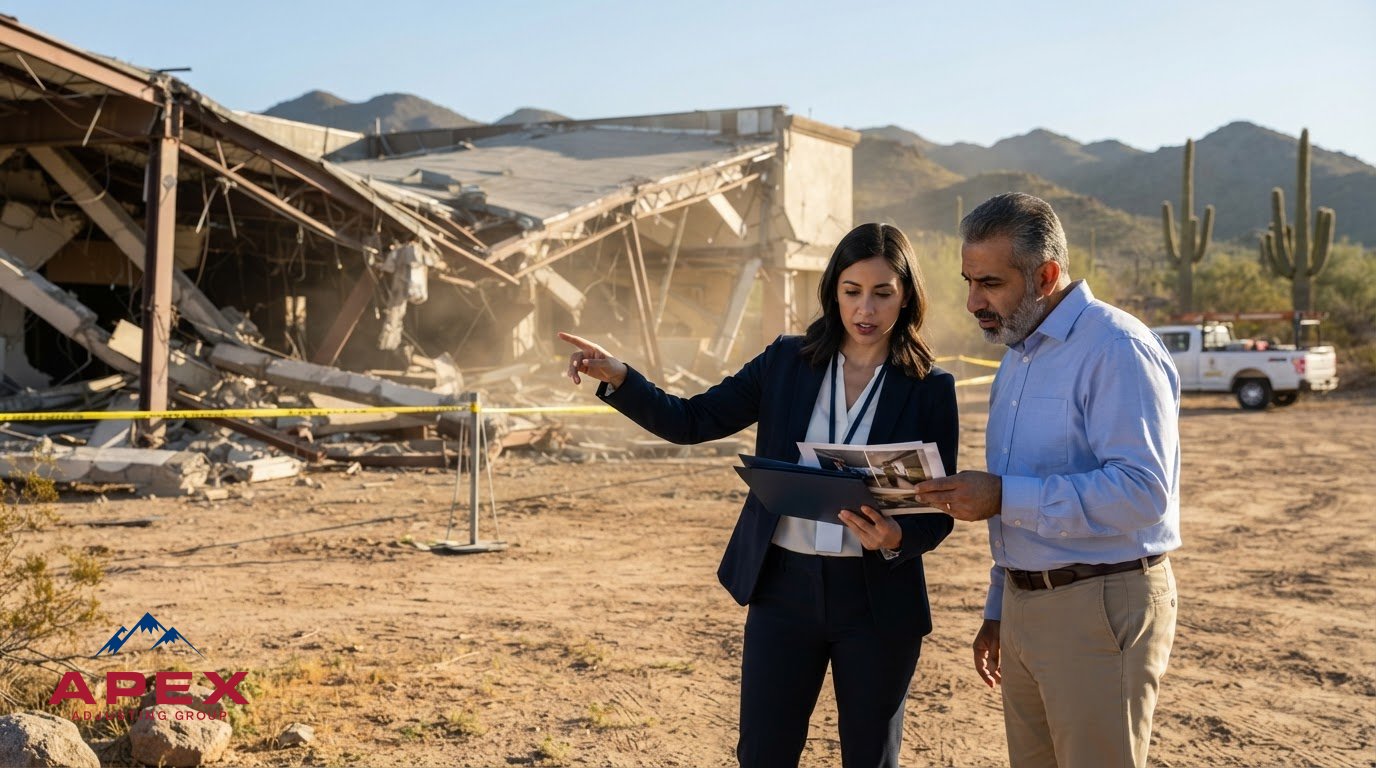
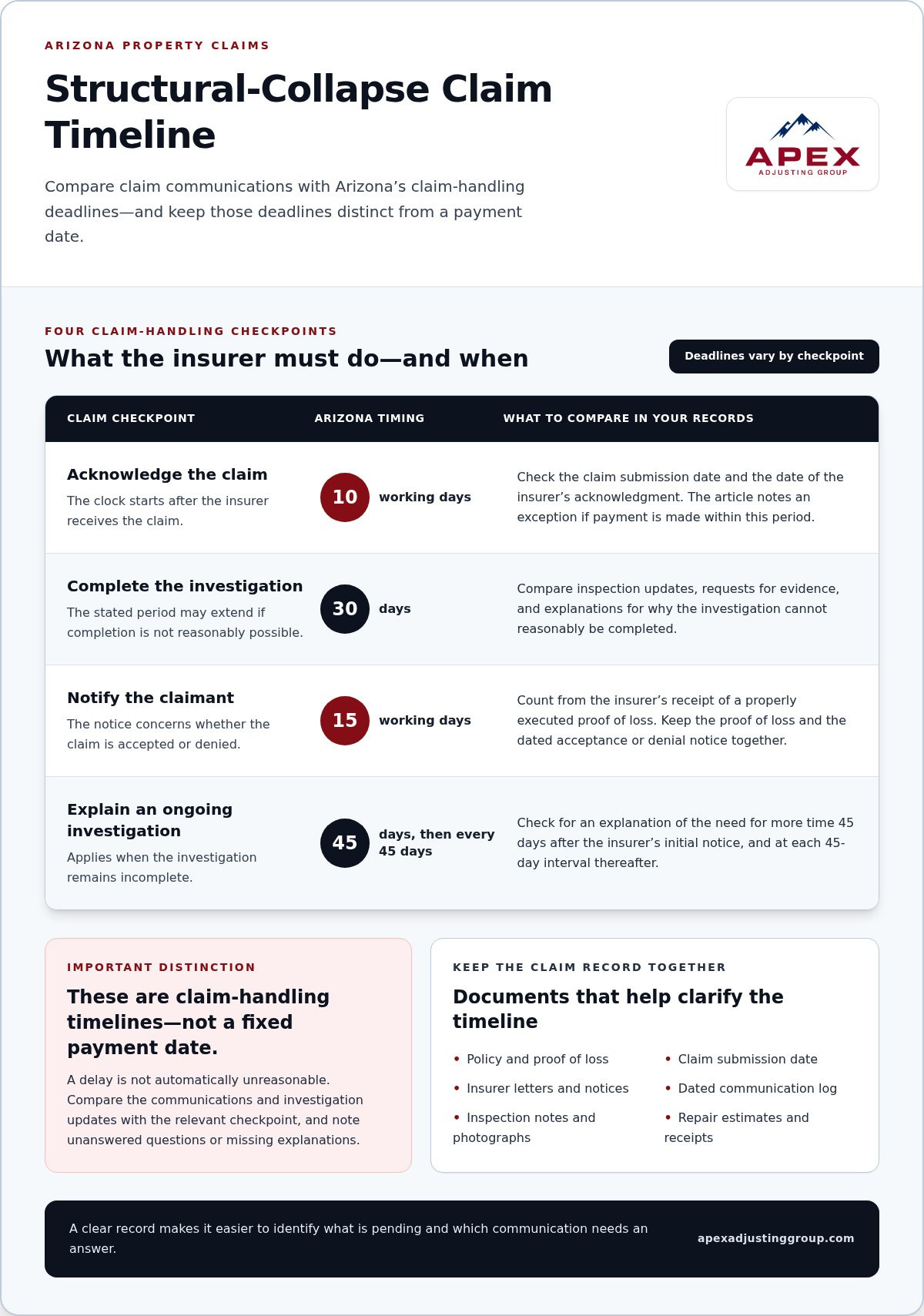
A structural-collapse payment delay isn’t automatically unreasonable, but Arizona sets deadlines for handling a claim. An insurer must acknowledge a claim within 10 working days, complete its investigation within 30 days unless it can’t reasonably do so, and notify the claimant whether the claim is accepted or denied within 15 working days after receiving a properly executed proof of loss. If the investigation remains incomplete, the insurer must explain the need for more time 45 days after its initial notice and every 45 days thereafter. Knowing what to do when insurance delays a structural-collapse payment in Arizona starts with comparing the claim timeline against these requirements, which govern claim handling, not a fixed payment date.
Waiting while a damaged building remains unsafe or unusable is stressful. When insurance delays a structural collapse payment in Arizona, first distinguish a documented investigation from a pause with no clear explanation or unanswered questions.
The next steps are to check how your policy defines collapse, ask what evidence or investigation is holding up payment, and keep an organized record of the damage and your communications. A careful review can clarify what remains unresolved.
Key Takeaways
- Compare claim communications and investigation updates with Arizona’s claim-handling timelines to identify unanswered delays.
- Review the policy’s collapse wording and the evidence of sudden physical damage, structural impairment, and loss of intended use.
- If collapse coverage is disputed, examine other policy provisions that may address the cause of damage or resulting loss.
- For commercial claims, separate the cost of the collapsed portion from standing sections and document the cause and scope of damage.
- Arizona Revised Statutes § 20-461, according to the Arizona State Legislature, defines specific unfair claim settlement practices; organized claim records can help clarify whether a delay deserves further attention.
Does Insurance Cover a Building Collapse?
Collapse coverage depends on the policy wording, the cause of damage, and the evidence. A denial does not always end the review: other policy provisions may cover parts of the loss.
Policy Definitions of Collapse
A policy’s collapse definition sets the physical conditions required for coverage. The ISO collapse provision generally describes an abrupt falling down or caving in that leaves the building, or part of it, unfit for its intended use. It also says that a building merely in danger of falling is not in a state of collapse. This distinction can affect whether cracking or sagging supports a collapse claim.
Compare the policy’s exact wording with the observed damage and the reported cause. Policies issued before 2000 may use different collapse language from policies issued after 2000. If the insurer denies collapse coverage, review other provisions for coverage tied to the cause of loss or resulting physical damage. A denial under one provision does not necessarily resolve every coverage question. Owners can also review the wording and scope of structural collapse claim support.
Ask the insurer to identify the policy language and evidence behind its decision. If the claim was denied, you can request in writing that the insurer reopen and reinvestigate it, particularly if new engineering findings or damage records address the reason for denial. Attach the denial, relevant policy pages, and new evidence, and keep a copy of your request.
Claim Evidence and Expert Support
Claim evidence should connect the building’s condition, the cause of collapse, and the repair scope. A structural engineer can assess the failure and document affected components; a loss consultant can help substantiate the loss scope. The evidence needs to establish both that covered damage occurred and the amount attributable to it.
Keep the policy, proof of loss, insurer letters, inspection notes, photographs, and repair estimates together. Photograph visible damage from a safe location, including displaced walls, fallen materials, and unsupported framing. Retain dated images, contractor invoices, and receipts for temporary protection. These records help show what changed and which costs relate to the collapse.
Arizona insurers must acknowledge a claim within 10 working days after receiving it, unless they make payment within that period. If the response is missing, document the submission date and follow up in writing. For owners deciding what to do when insurance delays structural collapse payment in Arizona, a clear timeline can expose unanswered communications without confusing acknowledgment with payment approval.
To raise a concern about a delayed claim, submit a complaint to the Arizona Department of Insurance and Financial Institutions. Include the policy, claim correspondence, any denial or explanation of the delay, and a dated communication log. After a collapse, keep people away from unsafe areas and contact emergency services if there is immediate danger. Photograph conditions only from a safe distance. Arrange reasonable temporary protection against further damage, and keep receipts and records of each measure.
Commercial property insurance coverage for building collapse
Payment for a commercial collapse claim depends on the policy form, the cause, and the damaged property. A building may have serious structural damage without meeting the policy’s definition of collapse. Compare the insurer’s explanation with the policy wording and documents supporting the loss.
Commercial policies address collapse differently under Basic, Broad, and Special Forms. Under the Basic Form, collapse may be covered when caused by a listed peril, such as fire or windstorm. Coverage under the Broad Form depends on the policy wording and circumstances of the loss. The Special Form covers risks of physical loss unless the cause is excluded. These differences make evidence of the cause central to the claim review.
For example, if a windstorm damages a roof and a supporting section then gives way, preserve inspection records, photographs, and engineering findings that connect the events. If the insurer alleges deterioration or another excluded cause, compare that explanation with the evidence and policy exclusions. Calling damage a “collapse” does not establish coverage on its own: the policy wording and cause guide how the loss is evaluated.
Ordinance or Law coverage, if included in the policy, may address costs beyond direct physical damage. Depending on its terms and limits, it may pay for debris removal, demolition, and increased construction costs required to meet current building codes. Keep separate estimates for each category. For example, list removal of collapsed materials separately from code-required upgrades to the remaining structure.
A settlement estimate should identify damaged components, quantities, the cause, and the applicable policy terms. Compare it with contractor estimates, engineering findings, invoices, and photographs. If the insurer omits a collapsed section or assigns a different cause, respond in writing with the specific discrepancy and supporting documents. A low offer alone does not establish misrepresentation; a documented mismatch gives the insurer a clear issue to address. An attorney can advise on legal questions, while claim records show the scope and costs in dispute.
Arizona homeowners can ask the insurer for an advance or partial payment for urgent repairs, but payment depends on the policy, coverage determination, and evidence supporting the amount. Make the request in writing, describe the emergency work, and attach estimates or invoices. Do not assume an advance is automatic.
For a commercial file, organize the policy form, cause evidence, code-related estimates, and disputed line items together. A focused commercial collapse claim review can help identify where the estimate and documented loss differ.
Insurer communication and investigation delays
A pending structural-collapse claim may involve inspections, engineering review, and questions about the cause of damage. Arizona has specific claim-handling timelines, but they do not set a fixed payment date. Track each event separately: notice, insurer acknowledgment, investigation activity, proof of loss, and coverage decision.
An Arizona insurer must acknowledge a claim within 10 working days after receiving it, unless it makes payment within that period. It must also reply within 10 working days to pertinent claim communications that reasonably indicate a response is expected. Record when each message was sent and received. A missing response to a specific request is easier to identify than a general feeling that the file has stalled.
The insurer must complete its investigation within 30 days of receiving the claim unless it cannot reasonably finish within that time. A complex collapse investigation may involve site access, structural observations, cause analysis, and damage estimates. Those tasks can explain ongoing work, but the file should show what remains under review. Ask which inspection, document, or finding is still needed and how it affects the open portion of the claim.
If the investigation remains incomplete, the insurer must explain the need for more time 45 days after its initial notice and every 45 days afterward. Keep each explanation with the claim correspondence. Compare updates over time: an extension that identifies a pending engineering report gives a concrete reason; repeated notices without meaningful detail may leave the delay unclear.
Use a dated claim log to keep the record clear and help identify unresolved issues. Note each inspection, document submission, phone call, and written response. After a call, send a brief email summarizing the discussion, such as a request for framing photographs or an engineer’s findings. Keep copies of attachments and record whether the insurer confirmed receipt.
- Separate requests for information from decisions about coverage or payment.
- Identify each unanswered question and the date it was sent.
- Ask for a written status explaining pending investigation tasks.
- Match every extension notice to the work still outstanding.
- Preserve photographs showing the affected portion and any standing structure.
These steps help distinguish a documented investigation from an unexplained pause and keep questions about cause, scope, and payment separate. If the insurer requests another inspection, record the access arrangements and keep the resulting report. A clear chronology gives the insurer a focused record to address and helps you assess whether communications remain timely.
Consulting a public adjuster
A public adjuster can review a structural-collapse claim from the property owner’s perspective. This may help when the insurer’s estimate omits damaged components, disputes the cause, or does not explain a payment delay. The adjuster reviews the policy, claim file, damage records, and estimate to identify differences between the assessment and documented loss.
Bring the full claim record to the review: the policy and endorsements, insurer letters, inspection reports, photographs, contractor estimates, invoices, and any structural engineer’s findings. For example, if the insurer’s estimate includes a damaged roof but omits compromised framing, compare the scope line by line with photographs and expert documentation.
A public adjuster can organize the loss presentation, document damage categories, and provide supporting information to the insurer. For a collapse claim, this may mean distinguishing the failed structural section from standing areas, separating emergency expenses from reconstruction costs, and explaining how observed damage relates to the reported cause. This work supports a clearer claim record but does not replace an engineer’s structural analysis.
- Gather the complete policy, including collapse and exclusions language.
- Sort photographs by area and date, with captions identifying visible damage.
- Match estimates and invoices to the affected building components.
- Keep a dated record of insurer requests, responses, and inspections.
- Separate emergency protection expenses from permanent repair estimates.
Use the review to identify specific gaps rather than relying on a general disagreement over value. A useful comparison points to an omitted beam, an unsupported repair quantity, or an estimate that does not account for documented demolition. Tie each disputed item to evidence and policy language. Keep updated estimates so changes are easy to track.
Understand the adjuster’s role before authorizing representation. A public adjuster handles the insurance claim adjustment; a lawyer addresses legal questions. If the insurer presents a settlement, compare its scope and supporting documents with the damage records before deciding whether to accept it. An adjuster can clarify claim components but cannot provide legal advice or control the insurer’s decision.
For a delayed or underpaid claim, a focused review can show whether the file needs stronger documentation, a clearer repair estimate, or a more precise explanation of the loss. It can also identify which expenses have supporting records and which need further documentation. Bring unresolved questions and the latest insurer correspondence so the review reflects the claim’s current status.
What may constitute an unreasonable insurance payment delay
A long wait alone does not establish an unreasonable delay. More concerning are unexplained pauses, shifting requests, or no clear link between outstanding investigation work and withheld payment. Compare the insurer’s stated reason with the documents, dates, and unresolved damage issues in the claim file.
Arizona Revised Statutes § 20-461 defines specific unfair claim settlement practices, according to the Arizona State Legislature. The statute makes the handling process relevant, not just the final amount. Review whether the insurer has explained its position, addressed submitted evidence, and communicated a consistent reason for delaying or withholding payment.
A reasonable investigation may require access to the property, structural findings, or documents supporting the claimed amount. Each request should relate to an issue in the claim. For example, a request for an engineer’s report may address cause or structural scope; repeated requests for records already provided may leave the reason for delay unclear. Keep copies and note when you sent each item.
Arizona insurer bad-faith rules and deadlines for suing over an unpaid claim involve legal questions that a lawyer should assess. Arizona homeowners’ policies typically set a 12-month deadline for filing a lawsuit related to a claim, although applicable state law may extend that period. The policy language, claim dates, and any applicable extension can affect the deadline.
Look at the claim’s overall pattern rather than judging one unanswered message in isolation. An insurer that identifies a pending inspection and later explains its findings presents a different record from one that gives no meaningful update or changes its explanation without addressing contrary evidence. Concern may also arise when the insurer has enough information to assess part of the loss but leaves that portion unresolved without explanation.
- Match each delay explanation to a specific outstanding task or document.
- Record when requested materials were submitted and whether receipt was acknowledged.
- Compare the insurer’s estimate with documented damage and the claimed amount.
- Ask in writing which issue prevents a decision on any undisputed portion.
- Preserve letters, estimates, inspection records, and a dated communication log.
These steps create a practical record of the insurer’s actions and the evidence available at each stage. If the file shows an unexplained pause or repeated requests without a clear purpose, ask for a written explanation and identify the unresolved items. An attorney can address legal rights and deadlines; claim documentation helps clarify the adjustment dispute.
Apex Adjusting Group: Fire Damage Claims
Apex Adjusting Group represents property owners in first-party property damage claims. If a claim is delayed or appears underpaid, its team can review the policy, insurer’s estimate, damage records, and claim correspondence to identify unresolved questions about scope or valuation.
For a structural-collapse dispute, organized evidence matters. Inspection records, photographs, repair estimates, and communications can show how documented damage relates to the claim. Apex Adjusting Group also handles fire and water damage claims, which may involve related damage to the property.
A public adjuster represents the property owner in the insurance adjustment, not the insurance company. Apex Adjusting Group offers a free claim review. Contact the team to discuss your claim.
Take the next step with a clearer claim file
A stalled structural-collapse claim can leave property owners unsure what to address first. If you’re deciding what to do when insurance delays a structural collapse payment in Arizona, focus on the difference between the insurer’s position and the evidence supporting your loss. A focused claim review can turn that difference into specific questions about coverage, scope, or documented damage.
Apex Adjusting Group represents property owners in first-party claims and reviews how the available records support a claim. Its services include structural collapse, fire damage, water damage, and commercial property claims. A review may help when an estimate omits damage, payment is delayed, or the insurer’s explanation does not address submitted documents.
Gather the policy, correspondence, estimates, photographs, and inspection findings in one place. An organized file gives the next discussion a practical starting point and keeps attention on the unresolved claim issues.
Clear documentation can help you decide what to do next with greater confidence.
Frequently Asked Questions
What Is Considered an Unreasonable Delay in Insurance Payments?
A delay may be unreasonable if the insurer gives no clear, claim-specific reason for withholding payment or fails to address evidence you submitted. For example, if you send an engineer’s report and revised repair estimate but receive no response explaining what remains under review, that gap deserves attention. Compare each explanation with the dates, requests, and documents in the file. A lengthy investigation alone does not establish an unreasonable delay.
What Does This Mean for Policyholders?
Keep the claim active and the record organized rather than relying on phone conversations alone. Save emails, letters, estimates, inspection findings, and proof that you sent documents. If the insurer’s payment covers only part of the building, compare its estimate with each documented damaged area. A clear record shows what remains disputed and supports a focused written request for the insurer’s position on those items.
Why are building collapse claim so complex?
Collapse claims can involve several linked questions: what physically failed, what caused it, which policy language applies, and what damage costs resulted. A roof failure, for example, may affect framing, interior finishes, equipment, and business operations in different ways. Engineers can assess structural conditions, while estimates and invoices help establish repair scope. Assessment can be more difficult when parts of the structure remain standing or damage developed in stages.
What Arizona laws regulate delays in homeowners insurance claim payments?
Arizona Revised Statutes § 20-461 defines specific unfair claim settlement practices, according to the Arizona State Legislature. Arizona claim-handling rules also set timelines for acknowledgment, investigation, communications, and a decision after a properly executed proof of loss. These requirements address claim handling, not a universal deadline for issuing payment. For a specific legal interpretation of how a rule applies, consult an Arizona attorney.
How long does an Arizona insurer have to acknowledge, investigate, and pay a structural collapse claim?
An Arizona insurer must acknowledge a claim within 10 working days, complete its investigation within 30 days unless it can’t reasonably do so, and notify the claimant of acceptance or denial within 15 working days after receiving a properly executed proof of loss. If the investigation remains incomplete, time-extension explanations are due every 45 days after the initial notice. These are handling deadlines, not a fixed payment date.
How do Arizona homeowners policies define structural collapse, and what exclusions apply?
Many policies define collapse as an abrupt falling down or caving in that makes a building, or part of it, unfit for its intended use. Some wording excludes a building merely at risk of falling, even if it shows sagging, cracking, or leaning. The cause matters too: exclusions and covered-cause provisions can affect the policy’s response. Read the specific collapse provision alongside the exclusions and endorsements.
How to get an independent structural engineer or adjuster for a disputed Arizona collapse claim?
For an independent engineering assessment, arrange an inspection focused on the cause of failure, affected structural components, and extent of damage. Ask for written findings that distinguish observed conditions from conclusions and include supporting photographs. A public adjuster can review the policy and claim valuation while representing you in the insurance adjustment. Keep the engineer’s report, estimates, and insurer correspondence together so each professional can address the same disputed facts.
What are Arizona insurer bad-faith rules and deadlines for suing over an unpaid claim?
Arizona Revised Statutes § 20-461 defines specific unfair claim settlement practices, and unjustified delays may constitute insurance bad faith. Homeowners’ policies typically set a 12-month deadline to sue over a claim, although applicable state law may extend it.
Need Help with Your Insurance Claim?
Our licensed public adjusters can help you get the maximum settlement you deserve. Contact us today for a free claim evaluation.
Related Articles